Visit Page
Skip to content

Trout Nation Posts

One of these things is not like the other. TW: Rape

Posted in Uncategorized

I’m not going to make this long, and I’m not going to call out anybody or name names or anything. I just feel like this needs to be said, and I don’t want to add fuel to the fire that resulted in me needing to make this post, and I want it to come across as sensitively as it possibly can. I keep feeling like it reads like a scolding, and it’s not meant to be one. It’s just bursting to get out.

In 2001, I went on a date with someone. Somebody I thought I could trust, because he was friends with someone I trusted. He was really nice and sweet and we’d talked on the phone a couple of times, and we decided to meet for drinks. We hit it off, and at some point, I got up to go to the bathroom and I left my drink on the table.

I probably don’t need to go into anything further than that. You get it. And it wasn’t even the first time a guy did this to me. Almost every woman I know has had this happen to her. If this has happened to you, I don’t care if you’re my worst fucking enemy in the world, I don’t care if you hit my dog with your car, if you lived through this, I’m so sorry that it happened to you. But I read something in which someone described a situation they were currently in, an intensely emotional and fraught situation, as feeling similar to when they were raped. And while I don’t want to police the feelings of other people on the subject of their own experiences, it struck me as an inappropriate comparison. But it happens all the time. I know I’ve done it in the past, before I realized that it’s impossible to separate what happened to me from what’s happened to lots of other people. Before I realized that survivors can victimize each other, no matter their intentions.

This is one of those rare occasions where I debated whether or not to post, because I’m so afraid of what will be said to/about me about something this personal. But no one seems to be talking about this. Even people I admire, whom I know must have noticed. And I know for a fact that there are other people who were similarly triggered by this comparison. So I had to get it off my chest.

There’s a potential for emotional injury here, so that’s why the comments are closed. This isn’t for gossip, it isn’t for discussion. It’s just something I had to say. No matter who you are, no matter what your experience was, no matter what you’re feeling, or how similar it feels to your experience, remember that you’re not the only person who has had that thing happen to them. When you compare something to rape, you’re comparing it to someone else’s rape, too, minimizing and trivializing their trauma. And if you accidentally compare someone to your rapist, you might be comparing them to their rapist. The psychological harm that causes a person… I can’t even imagine how I would feel if someone did that to me.

So, that’s it. Just please don’t compare stuff that isn’t rape to rape. And I’m sorry that it happened to you, too.

Merlin Club S04E10, “A Herald of The New Age” or “I feel like I’ve seen dripping children before.”

Posted in Uncategorized

merlinbanner2

Merlin club is a weekly feature in which Jessica Jarman, Bronwyn Green, and myself gather at 8pm EST to watch an episode of the amazing BBC series Merlin, starring Colin Morgan and literally nobody else I care about except Colin Morgan.

Okay, I lie. A lot of other really cool people are in it, too.

Anyway, we watch the show, we tweet to the hashtag #MerlinClub, and on Fridays we share our thoughts about the episode we watched earlier in the week.

The Joelist Book of The Dead, pt. 2, “The River of Dreams”

Posted in Uncategorized

In case you missed part one of this series, you can find it here. This post will make more sense in context. As with “Lullaby (Goodnight, My Angel),” I have not sought out other analysis from either Billy Joel or other sources.

Apparently, a common theme in dreams (human dreams, at least) is trying to cross a bridge or a river. I have this dream a lot; sometimes I can cross the bridge, other times my car blows off into the river (one of my worst fears and the reason I dread crossing the Mackinac bridge every year). On the occasions I’ve made it across the dream-bridge, I’m usually then involved in some kind of incidental meeting with a dead relative. I was shocked when I relayed this dream to Bronwyn Green and she told me she’d had similar dreams, and that pretty much everyone has them, like the naked at school dream or those dreams where all your teeth fall out.

Can we talk about that for a minute? Because I always have way more teeth in those dreams than normal people should have in their mouths.

Anyway, when listening to Billy Joel’s “The River of Dreams” one day, I began to make some connections between my river dreams, the river dream he describes and, well, everyone’s river dreams. And as the song comes directly after “Lullaby (Goodnight My Angel),” a song I previously analyzed to be a message about immortality and a connection between the world of the living and the dead, I began to think of “The River of Dreams” as a universal interpretation of life, death, and the collective human consciousness.

Let’s consider the lyrics:

In the middle of the night
I go walking in my sleep
From the mountains of faith
To a river so deep
I must be looking for something
Something sacred I lost
But the river is wide
And it’s too hard to cross

Here we have a poetic description of a dream, a journey from “faith,” a belief so strong as to become reality to the faithful; here I’m interpreting it to mean knowledge of the waking world, and trust in what our conscious mind shows us. Moving from the conscious to the subconscious, the traveler begins a journey for knowledge of something that escapes upon waking. The source of the knowledge, however, is made unobtainable by an obstacle, i.e., the river.

And even though I know the river is wide
I walk down every evening and I stand on the shore
And try to cross to the opposite side
So I can finally find out what I’ve been looking for

This is a reoccurring dream, and so familiar that the dreamer has begun to consciously see a pattern. They are aware that something lies beyond the river, and that to learn that knowledge they have to cross over.

In the middle of the night
I go walking in my sleep
Through the valley of fear
To a river so deep
And I’ve been searching for something
Taken out of my soul
Something I would never lose
Something somebody stole

In our waking thoughts, fear of our own mortality might prevent us from speculating on the nature of our souls, but in the subconscious world of our dreams, we are free to meditate upon it. The sense that something has been taken from the dreamer, something that they should be able to access, but can’t, is perhaps because of the manipulation our cultural beliefs have in forming our thoughts.

I don’t know why I go walking at night
But now I’m tired and I don’t want to walk anymore
I hope it doesn’t take the rest of my life
Until I find what it is that I’ve been looking for

When conscious, the dreamer is frustrated at the lack of easy answers, without realizing that it won’t just take the rest of their life, it will take the end of their life to understand their place in the collective conscious. More on that after the next verse:

In the middle of the night
I go walking in my sleep
Through the jungle of doubt
To a river so deep
I know I’m searching for something
Something so undefined
That it can only be seen
By the eyes of the blind
In the middle of the night

“The jungle of doubt,” here could mean doubting the existence of a life after death. Likewise, the “eyes of the blind” can be interpreted as the knowledge gained by the dead in the world beyond. “Blind” and “unseeing” have been used to describe the dead in literature and spirituality, especially in Christianity, where Jesus “opened the eyes” of Lazarus in his tomb. Hence my earlier assertion that only through death can we truly “cross the river.”

I’m not sure about a life after this
God knows I’ve never been a spiritual man
Baptized by the fire, I wade into the river
That runs to the promised land

Christian theology points to baptism of fire to refer to the trials and tests faced by Christ and his disciples. So, baptised by the tests of life, the dreamer once again tries to cross the river to gain entrance to the land beyond.

In the middle of the night
I go walking in my sleep
Through the desert of truth
To the river so deep

The “desert of truth” refers to absence of divine spiritual truth in our conscious lives.

We all end in the ocean
We all start in the streams
We’re all carried along
By the river of dreams
In the middle of the night

The final verse leaves us in ambiguity; is the “promised land” a conscious state that exists only in dreams, a world we access upon death (our permanent sleep)? If so, that means that the life of each soul is entwined in the “river of dreams,” that forms one collective human experience in some kind of universal subconscious.

From this song, I’ve formed the Joelist belief in an afterlife built around the familiar locations in recurring dreams. When we die, we cross the river of dreams, and enter into communion with the thoughts and minds of others. Until then, our subconscious self still tries to unite us with that collective consciousness, even though we can’t cross the river yet.

The next part of the Joelist Book of The Dead will be “2000 Years,” a song that details the evil and the divine in human nature, and the eventuality of fate.

Don’t Do This…Ever?: (an advice column for writers): “Crowd Funding” edition

Posted in Uncategorized

The internet book world has been abuzz with discussion about the ethics and logistics of crowd funding books.

Well, not books, really. They’ve been talking about crowd funding an author’s career.

When author Stacey Jay’s publisher declined to contract the next book in her YA series, she took to Kickstarter to fund the project. This isn’t uncommon, on both fronts. Many authors have crowd funded books, and many authors–and readers–have seen a series they loved discontinued by a publisher due to poor sales. It sucks for everyone, and I should know; it happened to one of my books.

Bear with me while I tell this tale.

Back when I was writing as Jennifer Armintrout, the sales of my Lightworld/Darkworld series were definitely not enough to earn out the $50,000 per book advance I’d received for them. When it came time to contract my next book, I had what my agent referred to as a “bridge” contract, a single title contract that offered a lower advance (I believe I got $35,000). The idea was that the sales of my next book would be enough to lead into my next contract.

They were not.

Although American Vampire was critically well received, it sold for absolute shit. In four years, it has not earned out. In fact, I think at last count it was somewhere in the neighborhood of $20,000 short of earning back the advance. Unsurprisingly, Harlequin wasn’t interested in another book in that series. Meanwhile, readers kept asking me if American Vampire was a series, that they wanted another book, and would there be any more books in my Blood Ties series. At this point in my career, I was writing as Abigail Barnette and making about fifty bucks a month. That’s quite the income drop from $50,000 per book, in case you were wondering. Nothing I sent out was selling. I proposed a spin-off novel about a popular character in my Blood Ties series, offering to write it without an advance for Harlequin’s Carina line of e-books, and was turned down.

In short, my career had taken a nosedive.

Things are obviously going better now, but had Kickstarter been a viable option back then, I might have undertaken a campaign on my own to self-publish a novel or two. When the state is paying for your heat, you can’t afford to self-publish. I would have asked for money for editing, for cover art, for professional design, probably even for advertising. I would have done it in a heartbeat.

So, what is it that rankles me about the Stacey Jay controversy? Well, several things, and hardly any of them have to do with Jay herself.

Foremost, I’m really uncomfortable with the stance her defenders have taken. Many have claimed that what Jay did with her Kickstarter was simply obtaining an advance in a non-traditional way. But it just…isn’t. An advance is money a publisher gives you before the title is put on sale. The idea is that the book will “earn out,” and the publisher will make that money back. It’s a risk they take, and as Jane Litte pointed out on twitter:


On the other side of the issue, people defended Jay by suggesting that those who questioned her campaign simply didn’t value an artist’s time or money:  


But it isn’t that simple. Writing isn’t “work.” It’s a business. If I own a ketchup factory, that’s running a business. If I work at a ketchup factory, that’s work. The owner of the ketchup factory assumes a financial risk in putting their product out there. They have to produce the product and pay the workers. The workers get paid for the work they do, the raw ingredients get paid for, and at the end of the day, if the business owner has money left over, that’s profit. This isn’t a business model that should be alien to anyone.

But supporters of Jay don’t see it that way. They see complaints from readers, bloggers, and other authors as an attack on Jay and a denial of the need for compensation:


No one cares what Stacey Jay spends royalties or advances on. No one expects writers to starve. I’ve seen readers called “entitled,” as though they’re demanding free product. No one has, to the best of my knowledge, asked Stacey Jay to write a book without being paid. What people have been objecting to is that a writer is asking readers to provide them with profits before the product has been delivered. That is not the responsibility of the consumer. I cannot ask customers who bought my ketchup in the past to fund my factory so that I can continue making product I can profit from.

As for Stacey Jay, she has posted a public apology and declared that she won’t be writing YA anymore. And again, there are authors, bloggers, and readers who are furious, insinuating that Jay has been forced out of the YA community or that disagreeing with her business model is akin to a personal attack, but that’s disingenuous. Jay decided to take down the Kickstarter and announce her retirement from YA. And you know what? If she feels that’s a sound business decision, I won’t argue with her. I have two series that at the moment I don’t have immediate plans to finish, because I won’t make as large a profit from them as I will working on other projects (don’t worry, they’re not either of my current series). It sucks for readers, in the same way that it sucked to see GCB cancelled, or like how every time I find a moisturizer I like, they fucking discontinue it. If publishing is a business, then business decisions are being made. If they’re personal or emotional, that’s not the fault of the consumers. The consumers are voicing objection to a business model, not saying that they want free ketchup, or to intentionally bankrupt ketchup companies world-wide. No one, not one person, has asked Stacey Jay to write for free. She has simply rejected the idea of writing on spec.

Stacey Jay is a talented writer. Read her Night’s Rose, written as Annalise Evansand you’ll see another example of the true unfairness in publishing; she should be more well-known than she is (or was, I guess, since this is spreading like wildfire). But that’s not how it works out, a lot of the time. More people buy Heinz than exquisite gourmet ketchup (that’s a thing, right? “The fanciest dijon ketchups?” BNL would never lie to me). And no writer is guaranteed to be paid for their projects before they complete them; it’s really nice, but it’s not owed. And these days, it’s almost become the golden ticket (if Willy Wonka were about ketchup instead of chocolate. I’m not rewriting the whole damn post to make that metaphor work).

Readers asking not to bear the cost of a work’s production in advance aren’t asking for anything for free. They were just surprised and insulted to be asked to pay for the production of the supply before the demand was fulfilled. They were further insulted by the excessively dramatic predictions of authors starving with their children in the streets, made by writers who had the gall to say the objectors were the ones acting entitled. That behavior isn’t making a case for authors, and it certainly isn’t helping to support Stacey Jay.

No matter how much we love our books, writing isn’t a job. It’s a career. You’re running a business. And nobody is responsible for making the ketchup but you.

Tense Tooth Fairy Negotiations

Posted in Uncategorized

The last time my daughter, Wednesday, lost a tooth, it was at the dentist’s office.

“Are you going to leave that for the Tooth Fairy?” the dentist asked, moments after he wiggled the super loose tooth from her head.

She shook her head, looked him in the eye, and said, “No. She only gives you a dollar for your teeth. My teeth are worth more.”

The kid wasn’t joking. She didn’t leave her tooth for the Tooth Fairy that night, and she still has it put away somewhere for safe keeping.

Yesterday morning, she lost another tooth. Or, I should say, night before last. She woke up, frowned, and spit a tooth into her hand. This one, she informed me, was going to go to the Tooth Fairy, but it would be the last one if her financial demand wasn’t met: “If she doesn’t give me a hundred dollars this time, she’s not getting another damn tooth.”

We went about our ritual of sealing the tooth in an envelope and putting it in the Barbie Dream House for the Tooth Fairy to find. This morning, however, included in the envelope of money with a crudely drawn sigil of a tooth and a dollar sign, she received this letter:

tooth fairy

We read it together. She thought it over. Finally she said, “Okay, I get it. But I still think my teeth are worth more than a dollar.”

I guess my six-year-old is looking for someone willing to buy her teeth, is what’s happening here.

UPDATE: Wednesday just came home and said, “You’re the tooth fairy! You are!” I asked her how she figured it out, and she said, “Because you have money.” She’s very pleased at how smart she is, and she sounds like a detective in a television show: “At first I couldn’t figure out how you got the money in there… then I realized, you were sneaking into my room the whole time!”


The “Force Jess To Finally Watch Labyrinth” watch-a-long!

Posted in Uncategorized

If you were a youngster in the 80’s, there is a very high likelihood that one movie, and one movie alone, caused you to first be aware of the power of raw, forbidden sexuality.

LabyrinthBallroomscene


Jim Henson’s Labyrinth, a monument to fantasy, puppetry, and snugly packed male genitalia was the movie that made me first aware of the hotness of age gap dynamics. Bronwyn Green and I love this movie. We even have this friendship test for new people we meet: if someone doesn’t like Labyrinth, it is unlikely that we will have much else in common.

So imagine our horror when we found out that Jessica Jarman has never, ever, in her entire life, seen Labyrinth.

This is a situation that must be rectified. What better way than with a Twitter watch-a-long. And what better time than to celebrate David Bowie’s 68th birthday?

The “Force Jess To Finally Watch Labyrinth” watch-a-long!

Thursday, January 8th, at 9 P.M. EST

Hashtag: #MagicBulge

Hop on Netflix or start your DVD (or VHS. You know you own it on one of those formats) at 9 P.M. EST and tweet to the hashtag #MagicBulge. We can all share our fond memories of the vague discomfort caused by David Bowie’s tights.

Call for links re: Leelah Alcorn

Posted in Uncategorized

Yesterday someone left a comment on my rebuttal to Sarah Ditum suggesting it would be more helpful to post links to writing by transgender women on the subject, and I was like, “Hey, that is a great idea!” and said I would do that today. However, I find myself in a precarious mental health state this morning (probably all the holiday stress catching up to me) and I just can’t tackle the task. If you have links to posts, articles, etc. written by transgender women in rebuttal to Ditum’s piece, please post them in the comments section. Or, heck, anything you’ve read from transgender women regarding Leelah Alcorn, go ahead and post it here.

I want to stress that this isn’t because I don’t care, but because I have mental health issues that crop up at inconvenient times (and I feel like an asshole for even bringing it up in conjunction with this topic, I swear I’m not trying to make it all about me although I’m sure it comes off that way). I recognize that I have the privilege of walking away from a topic that doesn’t endanger me personally, but I am trying to avoid a full-blown mental health crisis and I feel that reading about suicide isn’t safe for me at this time.

But we do have a wide readership here, so signal boost away in the comments!

Merlin Club S04E09 “Lancelot du Lac” or “I get it, Lancelot from the Lake. That’s clever.”

Posted in Uncategorized

merlinbanner2

Merlin club is a weekly feature in which Jessica Jarman, Bronwyn Green, and myself gather at 8pm EST to watch an episode of the amazing BBC series Merlin, starring Colin Morgan and literally nobody else I care about except Colin Morgan.

Okay, I lie. A lot of other really cool people are in it, too.

Anyway, we watch the show, we tweet to the hashtag #MerlinClub, and on Fridays we share our thoughts about the episode we watched earlier in the week.

Sarah Ditum wants you to stop being so mean to the parents who murdered their child.

Posted in Uncategorized

I wish this wasn’t the first post of 2015. I wish there wasn’t a reason for this post at all.

You’ve probably seen the name and story of Leelah Alcorn, the teenage girl who committed suicide when her parents refused to accept that she was transgender. After being forced into conversion therapy with Christian psychologists who called her selfish for not accepting the gender assigned to her at birth, Leelah posted a suicide note on Tumblr that begged for a change in the way we treat transgender youth and laid the responsibility for her death directly at her parents’ feet. The suicide note went viral, sending shockwaves through the LGBTA+ community and reaching mainstream media in way that shone stark light on the child abuse perpetrated against transgender children and teens by their parents.

That Alcorn’s suicide note has been so widely read is nothing short of astonishing; many victims of suicide leave no explanation of their actions, or their posthumous statements are read only by close family and friends. In making such a personal, vulnerable moment public for the world to see, Alcorn left a powerful legacy. There would be no erasing and denying her identity, no matter what her parents put on her tombstone or told their community. Her suicide letter has become a beacon of hope in an otherwise hopeless situation, encouraging the world to reach out to transgender teens at risk.

Teens who, writer Sarah Ditum asserts, will use Alcorn’s suicide as a template to humiliate their parents. In her piece for The New Statesman, “If you believe trans lives matter, don’t share Leelah Alcorn’s suicide note on social media,” Ditum worries that the world-wide dialogue Alcorn began breaks important journalistic standards and will cause stress for Alcorn’s family:

Along with a sense of basic dignity and respect for the grieving family, they are the reason that journalists should always take into account the Samaritans’ best practice media guidelines

The lack of basic dignity and respect that caused Alcorn to take her own life isn’t a concern for Ditum, who dismisses Alcorn as an unreliable source in her own death:

The guidelines tell journalists to “avoid the suggestion that a single incident […] was the cause”: the report doesn’t discuss any possible underlying causes, but presents the reported hostility of Alcorn’s parents to her trans status as the sole contributing factor.

Ditum goes on to further doubt the veracity of Alcorn’s account of the experience that caused her take her own life:

“Consider the lifelong impact that a suicide can have on those bereaved by a suicide,” says the Samaritans; Alcorn’s parents are mentioned only as villains, based on a single source, and their grief is not acknowledged.

No outside source could bear witness to Alcorn’s mental anguish better than she could, but Ditum dismisses her as an unreliable narrator.

Ditum fears copycat suicides, not because the loss of another transgender child is a horrifying and unacceptable prospect, but because the abusers of these teens might be cast in what she perceives to be an unfair light:

 The message an unhappy, isolated trans kid can take away from this is that death will bring you all the validation you’re missing in life. Your last words will be republished around the world and your parents will be punished for their failure to understand you. The reports even include a proven method you can follow.

Her concern isn’t for future suicide victims, but the prospect that they might be given a voice in death. She defends the Alcorns from the public scorn they’re facing on social media and in the press, saying:

And there’s another disturbing aspect to the public reaction: Alcorn’s parents, and specifically her mother, have been directly harassed by those who blame them for the death of their child. It is hard to imagine much worse that burying a child, but to lose a child by suicide must bring an almost unbearable degree of self-reproach to the loss.

Considering the fact that Alcorn’s mother persists in describing her daughter as her son “Josh” and referring to her with he/him/his pronouns, it seems unlikely that “self-reproach” is a term that has even a passing acquaintance with the Alcorns’ grief vocabulary. They deny that their daughter committed suicide, stating in a Facebook status update that their son “Josh” was accidentally struck and killed by a vehicle during an early morning walk.

Ditum ignores these facts in favor of lavishing sympathy upon Alcorn’s abusers and offers what appears to be a thoughtful, philosophical view of the nature of life and death in the media:

 Human are messy, overlapping things, however we live and die. We are tangles of love and mistakes. All of us are more complicated than the flat symbolism of the martyr, and all of us deserve to be seen in our full untidiness – the kind of untidiness that would never make for neatly consumable news copy.

Yet one important component of this story is missing from Ditum’s piece, and that is Leelah Alcorn herself. Instead of recognizing her as the “tangle of love and mistakes” and the “complicated” human being that she was, Ditum reduces Alcorn and other suicidal transgender teens to petulant brats throwing fatal tantrums in manipulative bids to ruin their parents’ images. The impact Ditum fears is not that more transgender children will kill themselves, but that the parents of these abused children might come off as unsympathetic in stories where they are, incontrovertibly, the cause of their child’s death.

Leelah Alcorn asked the world to see her as a woman, as a person, and as someone worthy of being loved just as she was. Sarah Ditum asks the world to see her as a liar and wants us all to stay silent out of mock concern for transgender lives. Perhaps a better title for Ditum’s piece would have been, “If you really want to inspire transgender youths to commit suicide, here’s a how-to guide.”

Resolutions and Accountability Report

Posted in Uncategorized

Another year has blown straight on by. Does anyone else feel like they’re careening toward the grave? Just me? I’ll call my doctor.

Last year, I made some resolutions. Let’s see if I kept them:

1. I did knit the 4th Doctor’s scarf. It took me eight months, but I managed to finish the scarf in the car on the way to Authors After Dark in Charlotte. It turned out fantastic:

scarf 1scarf 2IMG956317

2. I spent more time doing fun stuff. In addition to knitting, I actually slowed down to read non-work related books, play World of Warcraft, spend way too much time on Tumblr, and, most excitingly (is that a word?) for me, I started learning how to draw. Here are some of my favorite pictures this year:

beautiful dick in the moonlight oh the humanity Weed Princess copic  test touched up

3. I stopped worrying about whether or not my house was spotlessly clean. I kind of fudged a little on this one by hiring a cleaning lady once a week, but I’m not kicking myself over the clutter and the utter nightmare of ripped up dog toys on the floor as much as I was before.

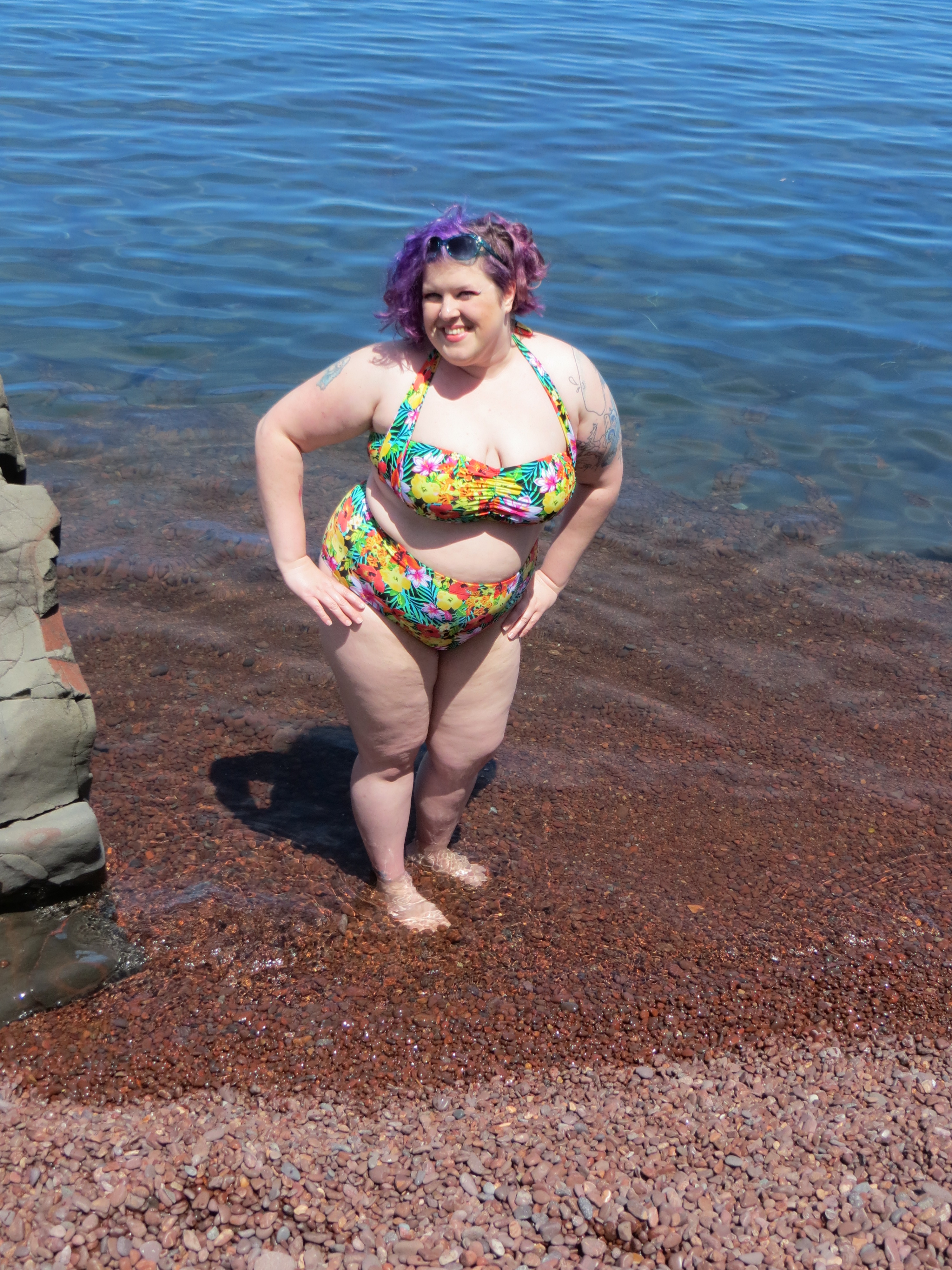
4. Wear a bikini.

038

So, there you have it. I, Jenny Trout, achieved my New Year’s resolutions.

Now, with 2015 upon us, I have a whole new set of resolutions.

1. Write another goddamn vampire novel. For personal reasons, I don’t do much talking about about my pre-Jenny Trout work, but my career started with a series of vampire novels. My plate is pretty full with two series right now (and the addition of a third barreling down on me), but I desperately want to write some vampire YA. Mostly because if there’s a genre that’s losing steam, I want to be sure to jump on the tail end of it and make absolutely no money. But what I lack in business sense, I make up for in passion and dedication, and right now my heart is telling me that I want to return to some vampires. By the end of 2015, I want to either have completed, or actively begun work on, a YA vampire novel.

2. Run the Mackinac 8 Mile. I got lazy and stopped doing something that made me happy. I’m going to start again, and I want to celebrate my return to running in 2015 by racing around the beautiful shores of Mackinac Island.

3. Draw a tattoo for myself. This year, I’ve gotten tattoos that other people have drawn. I’d like to get a tattoo that I drew. I don’t know what it will be of, or even if I have the skill to pull it off, but I’m going to keep practicing until I get it right.

4. Legally change my name to Jenny Trout. Do you have any idea how liberating it’s going to be to go from eighteen letters to ten letters? My name will finally fit on forms. I might even change my middle name, too. If anybody has any good ideas, let me know. Maybe we’ll have a vote on it or some shit.

I’m only making three this year, because I have a busy schedule with three books to complete and tons of travel in 2015, but let’s see how it goes!